

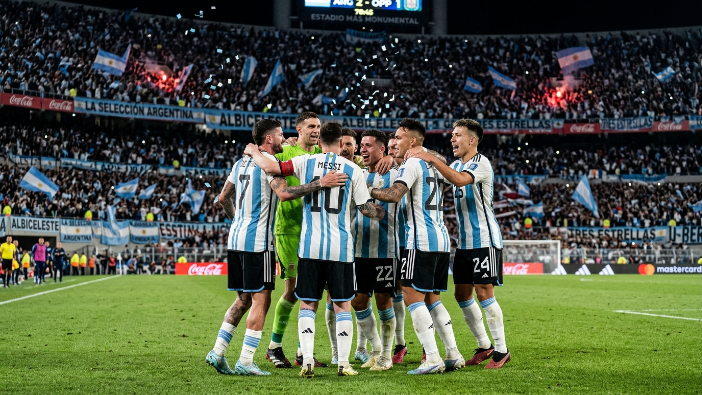
Millions of people watched Argentina defeat England and secure a place in the World Cup final. But behind the result was something bigger than soccer: a demonstration of leadership, resilience, trust, and teamwork under enormous pressure.
These are the same qualities companies look for when building strong, high-performing teams. Few situations, however, display them as clearly as a World Cup semifinal.
Here are some of the most valuable workplace lessons Argentina’s victory left behind.
Spain. Argentina.
— FIFA World Cup (@FIFAWorldCup) July 15, 2026
The #FIFAWorldCup Final. pic.twitter.com/mfcSIkYplu
Experience Remains a Competitive Advantage
At 39, Lionel Messi continues to perform at the highest level of international soccer.
For years, innovation and speed have often been associated exclusively with younger generations. Messi shows that experience does not compete with talent—it makes talent more effective.
The advantage is not always running faster. Sometimes, it is knowing when to accelerate, when to wait, and when to make the decisive move.
The same principle applies in the workplace. Experienced professionals bring judgment, perspective, and the ability to recognize situations they have faced before.
Successful companies do not choose between experience and younger talent. They build multigenerational teams where both can learn from each other.
Messi can’t use his right foot, he can’t score with his right. He wanted to assist that goal with his left foot but changed his mind, let’s give them a good highlight, he said, and boom. Did you see that Martinez was in the middle of two defenders? Messi made sure the one in… pic.twitter.com/9ieQWPfA8n
— Emeka United (@Emeka2026) July 16, 2026
Leadership Does Not Have to Be Loud
Messi has never been the loudest player on the field.
His leadership comes from his calm presence, consistency, and ability to respond when the team needs him most. He leads through his actions and gives his teammates confidence during moments of uncertainty.
In the workplace, effective leaders are not necessarily those who speak the most. They are the people who create clarity, remain composed under pressure, and help others believe that challenges can be overcome.
During difficult moments, employees pay more attention to how leaders behave than to what they say.
Your votes are in – Lionel Messi is the @MichelobUltra Superior Player of the Match! 👑
— FIFA World Cup (@FIFAWorldCup) July 15, 2026
#FIFAWorldCup #SuperiorPOTM pic.twitter.com/6J5skcancr
Resilience Is Built Before Success Arrives
Argentina’s journey did not begin with this victory.
The team has experienced painful defeats, intense criticism, generational changes, and enormous expectations. Instead of allowing those moments to define them, the players used them to build a stronger culture.
Resilience is not the absence of failure. It is the ability to recover, learn, adjust, and continue moving forward.
The same is true for companies. Resilient teams are not teams that never make mistakes. They are teams that can respond to setbacks without losing their sense of direction.
No Star Wins Alone
Messi may be the most recognizable figure on the team, but Argentina’s victory was a collective achievement.
Some players scored or created opportunities. Others recovered the ball, covered open spaces, supported their teammates, and completed tasks that rarely appear in the headlines.
Organizations work the same way.
Visible success may be associated with one leader or top performer, but there is almost always a larger team making that result possible.
Recognizing every contribution strengthens motivation, trust, and commitment across an organization.
Trust Reduces Uncertainty
Strong teams often create the impression that, even when circumstances become difficult, they know how to respond.
That confidence is not improvised.
It comes from preparation, repeated practice, clearly defined roles, and trust between teammates. Each player understands what is expected and believes that others will fulfill their responsibilities.
In the workplace, trust allows people to make faster and better decisions. When roles are clear and employees feel supported, they can focus on solving problems instead of protecting themselves.
Age Does Not Define Performance
For years, much of the conversation surrounding Messi focused on when he might retire.
Yet at 39, he continues to influence games against players who are significantly younger.
His performance offers an important reminder for employers: age alone does not determine a person’s value, potential, or ability to produce results.
Companies that make decisions based on generational stereotypes risk losing valuable knowledge and talent.
Age diversity becomes a competitive advantage when organizations encourage continuous learning and create opportunities for employees from different generations to collaborate.
Great Teams Put the Goal First
Argentina’s victory over England will be remembered as part of World Cup history. But the most important lesson may extend far beyond the field.
Extraordinary teams are not created overnight. They are built through shared experiences, clear goals, resilience, preparation, trust, and the understanding that collective success matters more than individual recognition.
Those principles can help a national team reach a World Cup final.
They can also help an organization overcome challenges, retain talent, and achieve results that once seemed impossible.