


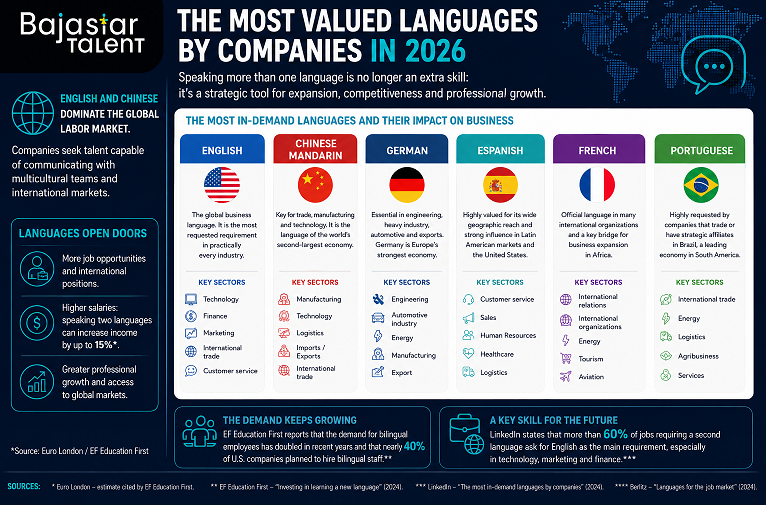
Speaking more than one language is no longer just an “extra skill” on a resume. In 2026, for thousands of international companies, language proficiency has become a strategic tool directly connected to global expansion, competitiveness and talent acquisition.
From technology and logistics to international trade, human resources and customer service, companies are prioritizing professionals capable of communicating with multicultural teams and international markets. In this scenario, English continues to lead as the most important language for business, while Mandarin Chinese is becoming increasingly relevant due to Asia’s economic and commercial growth.
Several international employment and recruitment studies show that bilingual and multilingual workers tend to have greater job opportunities, access to higher salaries and stronger professional growth potential. LinkedIn recently reported that more than 60% of jobs requiring a second language ask for English as the primary requirement, especially in areas such as technology, marketing and finance.
English: the language that dominates the corporate world
English remains the global language of international business. Technology companies, multinational corporations, startups and service firms use English as their operational language even when their offices are located outside English-speaking countries.
Virtual meetings, digital platforms, training sessions, corporate software and international negotiations are often conducted entirely in English. Because of this, many companies no longer view English as a competitive advantage, but as a basic requirement.
The demand for professionals with strong English skills continues to grow, especially in sectors related to remote work, programming, data analysis, digital marketing and global support services.
According to Berlitz, an international company specialized in language education and intercultural training, English remains the most requested language in the global job market, particularly in positions connected to international business and technology.
Recruitment experts also agree that bilingual professionals often gain access to higher salaries. EF Education First cited estimates from Euro London indicating that speaking two languages can increase income by up to 15%.
Mandarin Chinese: the strategic language of global trade
China’s economic growth has transformed Mandarin Chinese into one of the most strategic languages for international companies.
Businesses connected to manufacturing, imports, exports, technology and logistics are increasingly searching for professionals capable of communicating with Asian suppliers and clients.
Although learning Mandarin represents a greater challenge than many Western languages, its value in the labor market continues to rise, especially for professionals involved in international trade and global supply chains.
Several labor market analyses highlight that Mandarin Chinese has become essential for companies seeking to expand into Asian markets or strengthen commercial relationships with China.
German: one of the highest-paying languages
German continues to hold enormous importance within industrial and technical sectors. Germany remains one of Europe’s strongest economies and a global leader in engineering, automotive production, energy and advanced manufacturing.
Many companies highly value candidates capable of working with German clients or suppliers in highly specialized technical environments.
Recent studies on bilingual employment in Latin America even show that German is associated with some of the highest salaries in countries such as Argentina and Colombia.
Spanish: increasingly important in the United States
Spanish has become one of the most influential languages within the U.S. labor market.
The growth of the Hispanic population in the United States has led companies in customer service, healthcare, logistics, sales and human resources to prioritize bilingual English-Spanish workers.
Today, millions of Spanish-speaking consumers represent one of the most important markets for American companies, especially in states such as California, Texas and Florida.
In addition, Spanish has enormous geographic expansion throughout Latin America, making it a strategic language for companies with regional operations.

French: international business and expansion in Africa
French remains one of the most relevant languages for international organizations and companies operating in African markets.
Many businesses believe Africa will become one of the fastest-growing economic regions in the coming decades, and French serves as a key language across much of the continent.
French also continues to play an important role in sectors such as diplomacy, energy, tourism, aviation and international relations.
Portuguese: the commercial bridge to Brazil
Brazil’s enormous economic influence within Latin America has turned Portuguese into a highly valuable language for regional companies.
Businesses linked to energy, foreign trade, logistics and manufacturing constantly seek professionals capable of communicating with Brazilian clients and suppliers.
For many Latin American workers, learning Portuguese represents an accessible and strategic opportunity due to the cultural and commercial proximity with Brazil.
Languages increase employability
Human resources specialists agree that companies are no longer searching only for technical knowledge. Today, they prioritize professionals capable of adapting to multicultural teams, communicating with international clients and thriving in global environments.
EF Education First emphasized that language skills are becoming increasingly valued by companies seeking to build competitive businesses and expand internationally.
At the same time, labor platforms and consulting firms point out that artificial intelligence and automation are transforming the job market, making human skills such as intercultural communication and negotiation even more valuable.
In a global market where remote work and international teams are already part of everyday business operations, mastering languages is no longer simply an academic advantage. For millions of professionals, it has become a direct investment in stability, growth and international career opportunities.