

More and more companies are adopting robots, artificial intelligence, and automation to reduce costs and increase productivity. But the debate remains open: are robots really more profitable than people? Can they completely replace human talent? What happens if they get hacked? And, above all, what are the things they still cannot do?
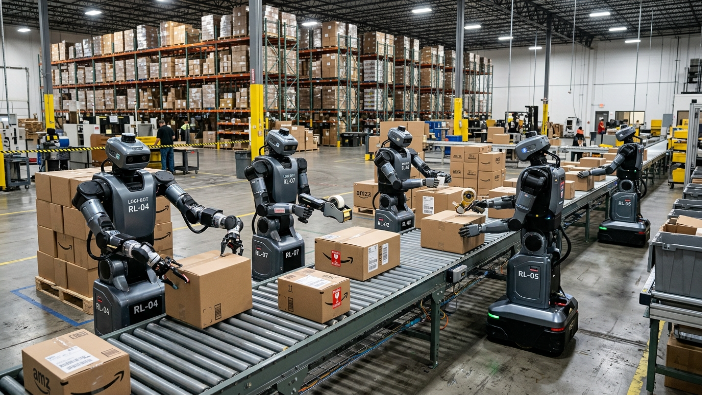
Automation is no longer a futuristic idea. Today, industrial robots assemble vehicles, algorithms screen resumes, AI systems handle customer service, and autonomous machines already operate in warehouses, hospitals, restaurants, and logistics centers.
In the United States, Asia, and Europe, investments in robotics have grown rapidly since the pandemic, driven by labor shortages, pressure to reduce costs, and the need to produce faster. Major companies such as Amazon, Tesla, Hyundai, and Foxconn expanded their automated systems, while small and medium-sized businesses began adopting more accessible AI tools.
However, behind the technological excitement lies an increasingly common question: will robots really replace people?
The answer is not that simple.
Is a Robot Cheaper Than Hiring Employees?
humanoid robots are now learning to build themselves
— Pukerainbow 🤮🌈 (@pukerrainbrow) May 20, 2026
we are the last generation that gets to be useful pic.twitter.com/XDFucx3626
In some industries, yes. In others, not yet.
An industrial robot can work 24 hours a day without breaks, vacations, or sick leave. It also does not require employee benefits, health insurance, or salary increases. For repetitive tasks, especially in manufacturing and logistics, automation often improves efficiency and reduces human error.
But the initial cost remains extremely high.
Implementing robotics requires investment in machinery, software, maintenance, technical specialists, and constant upgrades. An advanced industrial robotic arm can cost tens or even hundreds of thousands of dollars, not including installation and training.
Day 6 is live: Watch our humanoid robots running 24/7 and fully autonomous. We've now crossed 119 consecutive hours and 149,000 packages https://t.co/KI3sRSgzPQ
— Figure (@Figure_robot) May 18, 2026
In addition, not every company has the scale necessary to recover that investment quickly.
That is why many businesses discover that full automation is not always cheaper than maintaining human teams — especially in jobs where creativity, adaptability, or social interaction are essential.
In sectors such as customer service, human resources, education, healthcare, and sales, the combination of technology and people continues to be more effective than completely replacing workers.
The Risk Many Companies Overlook: Hacking
The more automated a company becomes, the more vulnerable it can also become.
Modern robots operate through connected networks, sensors, AI systems, and cloud platforms. That creates opportunities for cyberattacks.
Cybersecurity experts warn that a hacked robot could not only stop operations, but also cause physical accidents, information theft, industrial espionage, or multi-million-dollar damages.
In automated industrial plants, a cyberattack could shut down entire production lines. In logistics, manipulating autonomous systems could disrupt deliveries, inventories, or cargo movement. Even autonomous vehicles and medical robots represent new security challenges.
The problem is significant: many companies are adopting automation faster than they are strengthening their cybersecurity infrastructure.
As robotics expands, demand is also increasing for cybersecurity specialists, digital monitoring experts, and professionals capable of protecting intelligent systems.
What Robots Still Cannot Do
Although artificial intelligence is advancing rapidly, there are still human abilities that remain extremely difficult to replicate.
Robots can analyze data faster than humans and repeat tasks with precision. However, they still face major limitations when it comes to understanding emotions, interpreting complex contexts, or making ethical decisions.
A robot does not truly understand fear, empathy, intuition, or human social dynamics. It also cannot improvise with the same flexibility as a person when facing unexpected situations.
That is why many professions will continue to require human skills for decades to come.
Among them:
- Leadership and team management.
- Negotiation and conflict resolution.
- Artistic and strategic creativity.
- Critical thinking.
- Emotional care and human support.
- Interpersonal communication.
- Complex decision-making.
- Cultural and social adaptability.
Even in highly automated industries, companies still need people capable of coordinating teams, supervising processes, and solving problems that machines cannot fully understand.
Work Is Not Disappearing — It Is Changing
Historically, every technological revolution created fear around employment.
It happened with industrial machinery, computers, and later the internet. Many jobs disappeared, but new professions also emerged that previously did not exist.
The difference today is the speed.
Artificial intelligence and automation are evolving faster than many educational and labor structures can adapt. That forces both workers and companies to constantly evolve.
Today, new positions are emerging in AI training, algorithm supervision, automation management, data analysis, cybersecurity, and coordination between humans and intelligent systems.
Companies are no longer looking only for technical experience. They also value human abilities that are difficult to automate: communication, adaptability, leadership, and strategic thinking.
The Challenge for New Generations
For many young professionals, the biggest challenge will not be competing against robots, but learning how to work alongside them.
Future companies will likely operate through hybrid models: artificial intelligence handling repetitive tasks, while people focus on creativity, strategy, human relationships, and decision-making.
That also changes the type of talent organizations are seeking.
Static technical knowledge is no longer enough. Continuous learning and adaptability will be essential to remain competitive in an increasingly automated market.
Will Robots Completely Replace Humans?
In some repetitive jobs, probably yes.
But in many others, technology seems more likely to complement people rather than replace them entirely.
The companies that adapt best will probably not be the ones that eliminate people altogether, but the ones that successfully integrate technology and human talent in smart ways.
Because, at least for now, no robot can fully replace something essential: the human ability to create, empathize, lead, and understand the world beyond data.