

Remote hiring has unlocked global talent pools, but it has also introduced a critical challenge: trusting who is actually on the other side of the screen. For U.S. companies hiring in Mexico, identity verification has traditionally relied on documents, video calls, and manual checks—methods that, while useful, are far from foolproof.
That’s where Mexico’s biometric CURP changes the equation.
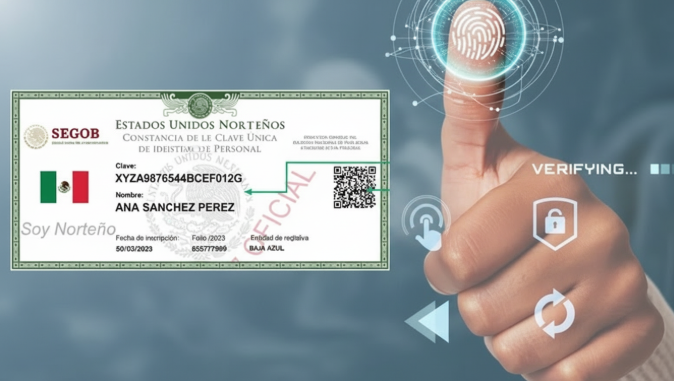
By integrating biometric data such as fingerprints, iris scans, and verified personal records, the CURP biométrica introduces a new level of certainty in identity validation. And for U.S.-based companies working with remote teams, this is not just a regulatory shift in Mexico—it’s a direct operational advantage.
A new standard for identity verification
One of the biggest risks in remote hiring is identity fraud. Candidates may present falsified documents, use someone else’s credentials, or create duplicate profiles across platforms. Traditional verification methods—like scanned IDs or even live video interviews—can be manipulated.
With the biometric CURP, identity is no longer based solely on documents that can be forged. Instead, it is tied to unique biological data that is nearly impossible to replicate.
This means that for employers:
- The person hired is verifiably the person working
- The risk of impersonation drops significantly
- Trust in remote hiring increases from day one
In practical terms, this shifts identity from being declared to being proven.
Fewer errors, cleaner operations
Another major challenge in international hiring is inconsistency in records. Duplicate profiles, mismatched documentation, or incorrect personal data can create serious issues in contracts, payments, and compliance.
Biometric identification helps eliminate these problems at the source.
Because each CURP biométrica is unique and linked to a single individual, it reduces:
- Duplicate or conflicting profiles
- Errors in legal documentation
- Issues in payroll processing
- Compliance risks across jurisdictions
For U.S. companies, especially those scaling remote teams, this translates into cleaner, more reliable operations.
Faster onboarding, less friction
Speed matters in hiring. The longer the onboarding process, the higher the chances of losing top talent or delaying operations.
With biometric verification, identity validation can happen almost instantly. There is no need for extended back-and-forth exchanges of documents, repeated confirmations, or manual checks.
The result is a smoother onboarding experience:
- Faster hiring decisions
- Reduced administrative workload
- Immediate validation of candidate identity
For companies managing multiple hires across borders, this efficiency becomes a competitive advantage.
Increased security in sensitive roles
Not all roles carry the same level of risk. Positions involving sensitive data, financial operations, or direct customer interaction require a higher level of trust.
This is especially true in areas such as:
- Customer support
- Fintech and financial services
- Data management
- Logistics and operations
In these contexts, knowing exactly who has access to systems, information, or customers is critical.
Biometric CURP strengthens this layer of security by ensuring that:
- Access is tied to verified individuals
- Internal risks are reduced
- Accountability is clearer
For U.S. companies, this means greater confidence when assigning critical responsibilities to remote teams.
What changes compared to the current model
Today, most U.S. companies hiring internationally rely on a combination of:
- Passports or government-issued IDs
- Scanned documents
- Manual verification processes
- Video interviews
While these methods are standard, they are not immune to fraud. Documents can be altered, identities can be borrowed, and even video calls can be misleading.
The biometric CURP introduces a fundamental shift:
👉 Identity becomes unique, verifiable, and significantly harder to compromise
This reduces one of the biggest hidden risks in remote hiring—something that often goes unnoticed until a problem arises.
It’s not automatic: companies must adapt
It’s important to note that the existence of biometric identification alone does not automatically solve hiring challenges.
To fully leverage this advantage, companies need to:
- Integrate identity verification into their hiring workflows
- Use platforms and partners that support biometric validation
- Adapt onboarding processes to include these checks
Without these steps, the potential benefits remain underutilized.
In other words, the tool exists—but companies must actively use it.
A competitive advantage for U.S. employers
For U.S. companies hiring remote talent in Mexico, the biometric CURP is more than a technological upgrade—it’s a strategic advantage.
It enables:
✔ Lower fraud risk
✔ Higher trust in candidates
✔ Faster hiring and onboarding
✔ Stronger operational control
In a global hiring landscape where speed and reliability are critical, these factors can make a significant difference.
The bigger picture for remote hiring
The introduction of biometric identity systems reflects a broader shift in the future of work. As remote hiring continues to grow, the need for secure, scalable, and verifiable identity systems becomes essential.
Mexico is taking a step in that direction—and companies that understand and leverage this change will be better positioned to build strong, reliable remote teams.