

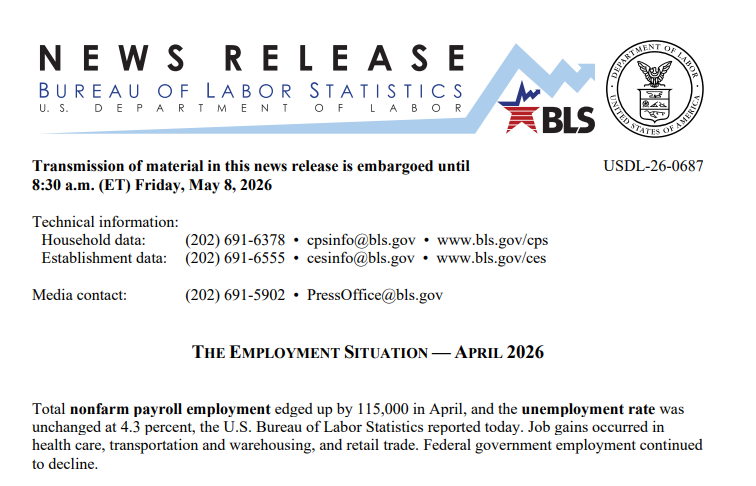
The U.S. labor market showed renewed signs of stability in April, delivering encouraging news for professionals looking for remote job opportunities with American companies: the country added 115,000 new jobs, while the unemployment rate remained stable at 4.3%.
The report, released by the U.S. Bureau of Labor Statistics (BLS), exceeded analysts’ expectations by a wide margin. Economists had projected much slower job growth, making April’s numbers another sign that many businesses continue expanding despite ongoing economic uncertainty.
While sectors such as healthcare, retail, transportation, and warehousing led hiring activity, the report also highlights a deeper shift taking place across the American workforce: companies are continuing to grow, but they are increasingly prioritizing agile, flexible, and efficient work structures.
And in that environment, remote bilingual talent continues gaining value.
Remote work is now part of the American business model
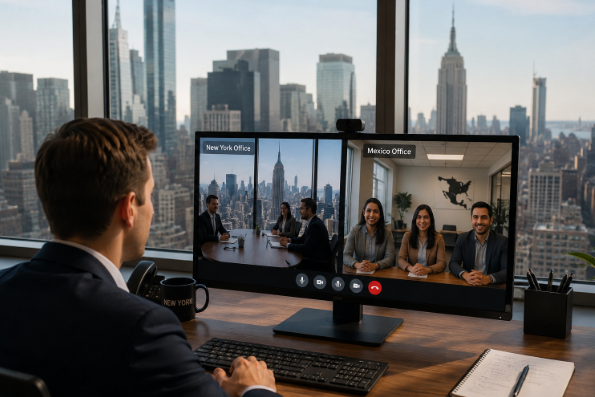
After the pandemic, remote work stopped being a temporary solution. Today, it has become a structural part of how thousands of U.S. companies operate, hire, and build teams.
Many businesses realized they could maintain productivity, reduce operational costs, and expand access to qualified professionals by hiring remote workers from Latin America.
That shift created new opportunities for bilingual professionals in areas such as:
- customer support,
- virtual assistance,
- administrative coordination,
- recruiting,
- digital marketing,
- sales,
- operational support,
- and back-office services.
More companies no longer require every employee to work physically from an office in the United States. Instead, they are prioritizing professionals who can integrate quickly into international teams and work efficiently in remote environments.
For many employers, hiring remote talent is no longer only about reducing expenses. It has also become a way to access qualified professionals with strong communication skills, compatible time zones, and experience working in digital workplaces.
Fewer workers available inside the U.S.
The latest labor report also reveals another important trend: the number of available workers inside the United States continues to decline.
Labor force participation dropped to 61.8%, its lowest level since October 2021. Factors such as mass retirements among baby boomers and stricter immigration policies are reducing the available workforce across multiple industries.
As a result, many companies are being forced to expand their talent searches beyond local markets.
At the same time, labor costs continue increasing. Although average wages rose 3.6% year-over-year, many businesses are still dealing with pressure from inflation, energy costs, transportation expenses, and rising operational spending.
That is one of the main reasons why nearshoring models continue gaining momentum.
Latin America has become one of the most attractive regions for U.S. companies looking to build stable remote teams, particularly because of time zone compatibility, strong professional talent, and the growing number of bilingual workers across the region.
Flexibility and efficiency are now top priorities
April’s employment growth shows that American companies are still hiring, even in an economy that continues facing uncertainty.
However, hiring priorities have changed significantly.
Today, companies highly value professionals who can:
- adapt quickly,
- work independently,
- communicate effectively,
- and operate comfortably in digital environments.
Flexibility has become a competitive advantage for both businesses and workers.
For many Latin American professionals, this means access to international career opportunities without needing to relocate to expensive U.S. cities. And for American companies, it provides access to qualified talent without the limitations of the traditional labor market.
More businesses are realizing that building remote teams does not reduce efficiency. In many cases, it actually improves productivity and operational performance.
A labor market that continues evolving
Although the global economic outlook remains challenging, April’s data confirms that the U.S. labor market is still generating real opportunities.
Economists continue monitoring inflation and economic slowdown concerns, but continued hiring growth shows that companies are still investing in talent and expanding operations.
At the same time, remote work is no longer viewed as a temporary trend. It has become a permanent part of the modern workforce.
For professionals looking to grow internationally, work with U.S. companies, or build bilingual careers from Latin America, the current market continues opening new doors.
The combination of technology, changing business needs, and shifting workplace culture is transforming how companies hire talent — and all signs suggest that transformation is only beginning.