


In an increasingly globalized labor market—where speed, responsiveness, and operational continuity define success—U.S. companies are discovering a quiet but powerful advantage: talent in Latin America is not only highly skilled, but also strategically positioned across time zones that naturally extend the workday.
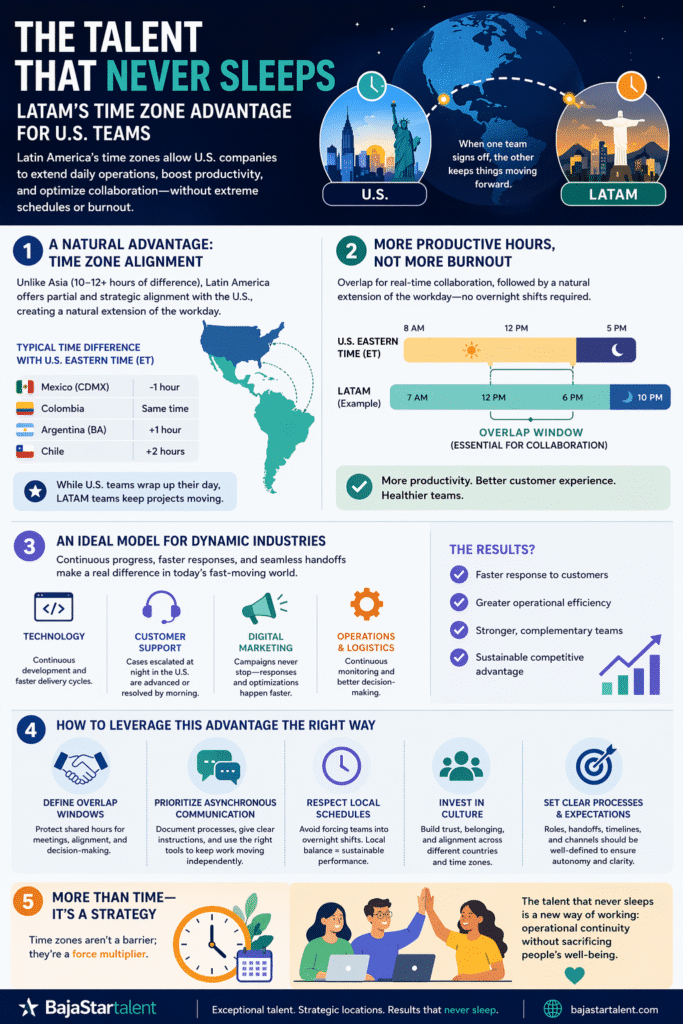
Unlike traditional outsourcing models in regions such as Asia, where time differences can exceed 10 to 12 hours, Latin America offers partial—and highly strategic—alignment with U.S. working hours. This means that while teams in New York or California are wrapping up their day, professionals in countries like Mexico, Colombia, or Argentina can still be actively working—resolving tasks, advancing projects, and preparing deliverables for the next business day.
This dynamic has given rise to what many companies are beginning to call “the talent that never sleeps”: distributed teams that, without working extreme or unsustainable hours, can maintain operational continuity for up to 16 or even 18 hours a day.
More productive hours without more burnout
The real value of this model is not just the extended coverage—it’s how that coverage is achieved. Unlike traditional night-shift or reverse-schedule systems, Latin American professionals can work within reasonable hours in their own local time zones.
For example, a team in Argentina can start its workday while the U.S. East Coast is just beginning, and continue contributing as U.S. teams move toward the end of their day. This creates a critical overlap window—essential for meetings, coordination, and decision-making—followed by a natural extension of productivity, without forcing anyone into overnight shifts.
The result is increased efficiency without the human cost of exhaustion—an essential factor at a time when burnout has become one of the biggest challenges in the modern workplace.
A perfect fit for fast-moving industries
Industries such as technology, customer support, digital marketing, operations, and logistics benefit especially from this time zone advantage. In these sectors, the ability to maintain continuity, respond quickly to clients, and keep projects moving without interruption can significantly impact outcomes.
For instance, support teams can escalate cases at the end of the U.S. workday and find progress—or even resolution—by the next morning. Similarly, development teams can hand off tasks in progress to LATAM counterparts, accelerating delivery cycles without increasing individual workload.
This model doesn’t just save time—it enhances customer experience and strengthens overall competitiveness.
How to leverage this advantage without getting it wrong
However, this “secret advantage” doesn’t work automatically. To fully unlock its potential, companies must design intentional strategies and avoid common pitfalls.
First, defining clear overlap windows is critical. These shared hours enable alignment, collaboration, and real-time decision-making. Without them, teams risk becoming disconnected silos.
Second, asynchronous communication must be prioritized. Documenting processes, leaving clear instructions, and leveraging collaboration tools allow teams to operate independently without relying on constant real-time availability.
Another key factor is respecting local schedules. The strength of the LATAM model lies precisely in avoiding disruptive or overnight shifts. Forcing teams to fully adapt to U.S. hours undermines the advantage and can lead to burnout, turnover, and talent loss.
Finally, companies must invest in organizational culture. Distributed teams across different countries require deliberate efforts to build trust, alignment, and a sense of belonging. This includes everything from onboarding processes to meaningful interaction beyond day-to-day operations.
More than a matter of time—it’s a matter of strategy
Latin American talent is proving that geography can be a strategic advantage when leveraged correctly. This isn’t just about cost efficiency or access to skilled professionals—it’s about rethinking how work gets done in a connected world.
In this context, time zones are no longer a barrier—they are a powerful optimization tool. Companies that successfully integrate LATAM teams into their operations won’t just gain more hours—they’ll gain agility, resilience, and adaptability.
The talent that never sleeps is not a myth—it’s a new way of working, where operational continuity is achieved without sacrificing people’s well-being. And in a world where balancing productivity and quality of life is increasingly critical, that may be the ultimate competitive advantage.