


Artificial intelligence has become one of the most widely used technologies in the world. Every day, millions of people turn to platforms such as ChatGPT, Google’s Gemini, Anthropic’s Claude, and Microsoft’s Copilot to answer questions, write documents, learn new skills, and solve everyday problems.
However, as these tools become more accessible, a growing concern has emerged among physicians, psychologists, and technology experts: people are increasingly using AI as a substitute for professional medical advice.
Today, it is common to see users asking chatbots questions such as:
- “Why does my chest hurt?”
- “Should I take this medication?”
- “Do I have depression?”
- “Could this be cancer?”
The problem is simple: no current AI system is designed to provide a real medical diagnosis.
AI Cannot Examine You
Modern AI models can generate responses that sound remarkably convincing. But medicine requires much more than generating plausible answers.
A physician evaluates medical history, asks follow-up questions, performs physical examinations, orders laboratory tests, reviews imaging studies, and analyzes multiple factors before reaching a diagnosis.
AI has access to none of that.
It only sees the information typed into the conversation.
If symptoms are described inaccurately—or if important details are omitted—the resulting response may be completely wrong.
A headache, for example, could be caused by stress, dehydration, lack of sleep, high blood pressure, medication side effects, or a serious neurological condition. Without proper medical evaluation, no chatbot can determine the cause with certainty.
What AI Cannot Do (And You Shouldn’t Ask It To Do)
| Area | What AI Cannot Do | Why |
|---|---|---|
| 🩺 Health | Diagnose diseases | It cannot examine patients or order medical tests |
| 💊 Medicine | Prescribe personalized treatments | It does not know your complete medical history |
| 🧠 Mental Health | Replace psychologists or psychiatrists | It lacks clinical training and genuine empathy |
| ⚖️ Legal Matters | Provide professional legal advice | Laws change and every case is unique |
| 💰 Finance | Make investment decisions for you | It cannot assess your financial situation |
| 🔮 Future Events | Predict the future with certainty | Markets, elections, and sports outcomes are unpredictable |
| 👤 Privacy | Reveal personal information about others | Systems are designed to protect private data |
| 🔑 Security | Provide passwords or account access | This is illegal and restricted |
| 📧 Private Communications | Read someone else’s emails or messages | AI has no access to private accounts |
| 🏦 Banking Information | Retrieve account or credit card numbers | Security protections prevent this |
| 💻 Hacking | Teach how to compromise systems | Restricted by safety policies |
| ⚠️ Illegal Activities | Explain how to commit crimes | Prohibited by platform rules |
| ☣️ Dangerous Substances | Provide instructions for drugs or explosives | Public safety risk |
| 😡 Hate Content | Promote discrimination or violence | Moderation systems prevent this |
| 👶 Parenting | Replace parents or educators | AI cannot supervise or care for people |
| ❤️ Relationships | Make personal life decisions | It lacks full context |
| 🚑 Emergencies | Function as an emergency service | Real emergencies require immediate professional help |
| 🕵️ Criminal Investigations | Determine guilt or innocence | It has no access to evidence |
| ⚖️ Complex Disputes | Decide who is right or wrong | Human judgment is required |
| 👨⚕️ Professional Expertise | Replace doctors, lawyers, accountants, or engineers | It can assist, but not assume responsibility |
The Risk of Misdiagnosis
One of the biggest dangers associated with AI health advice is the false sense of confidence it can create.
If a chatbot provides a reassuring answer, some people may delay seeking medical attention even when symptoms require urgent care.
The opposite can also happen.
A harmless symptom may trigger a response mentioning severe illnesses, causing unnecessary fear and anxiety.
Healthcare professionals often refer to this phenomenon as cyberchondria—anxiety fueled by excessive online health research.
With AI, the problem can become even more pronounced because the responses are delivered in a highly confident and human-like manner.
AI Systems Can Be Wrong
ChatGPT, Gemini, Claude, and Copilot are sophisticated statistical models.
They do not understand medicine in the same way a trained physician does.
Instead, they predict the most likely response based on patterns learned from massive amounts of data.
As a result, they can make mistakes.
They can generate inaccurate information, misinterpret symptoms, or even invent facts entirely.
The technology industry has a specific term for this: AI hallucinations.
An AI hallucination occurs when a model produces false information but presents it as if it were accurate.
In entertainment or casual conversation, these mistakes may be harmless.
In healthcare, they can have serious consequences.
AI Is Not a Therapist
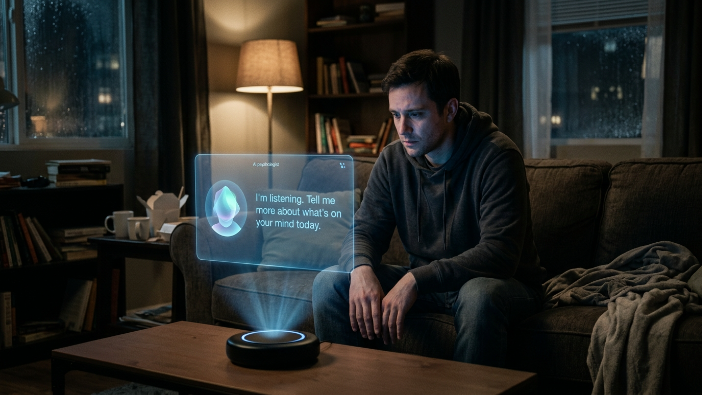
Another rapidly growing trend is the use of AI chatbots for emotional support and mental health conversations.
Many people discuss anxiety, depression, loneliness, family conflicts, or relationship problems with AI because it is available 24 hours a day, never appears judgmental, and responds instantly.
While these characteristics may make AI feel supportive, mental health professionals warn that chatbots cannot replace psychologists or psychiatrists.
AI lacks genuine empathy, clinical expertise, emotional understanding, and the ability to identify complex warning signs.
In situations involving self-harm, abuse, violence, severe depression, or emotional crises, relying exclusively on AI may delay critical professional intervention.
Privacy Matters Too
Another often overlooked concern is privacy.
Many users share highly sensitive details with AI systems, including:
- Medical conditions
- Diagnoses
- Prescription medications
- Family problems
- Psychological struggles
- Personal relationships
Although major AI companies implement privacy and security protections, cybersecurity experts generally recommend avoiding the disclosure of personally identifiable medical information.
The more personal data users provide, the greater the potential exposure in the event of misuse, system errors, or unexpected data handling practices.
For this reason, AI providers typically advise users not to enter full medical records, identification numbers, detailed clinical reports, or sensitive financial information.
How AI Can Actually Help
None of this means artificial intelligence is useless in healthcare.
In fact, it can be extremely valuable when used appropriately.
AI can:
- Explain medical concepts in simple language
- Help users understand general health information
- Describe how diseases work
- Provide educational information about medications
- Suggest questions to ask a healthcare provider
- Encourage healthy habits and preventive care
The key distinction is that AI should be used as an educational resource—not as a replacement for professional medical evaluation.
Even AI Developers Acknowledge the Limits
The companies behind ChatGPT, Gemini, Claude, and Copilot all share a common position: their products should not be used as substitutes for medical diagnoses, legal advice, or personalized financial guidance.
That is why these systems often display warnings and recommendations to consult qualified professionals when conversations involve serious symptoms, emergencies, or important health decisions.
This is not merely a technical limitation.
It is an acknowledgment that artificial intelligence still lacks the judgment, accountability, and clinical expertise required in modern healthcare.
The Most Powerful Technology Still Requires Common Sense
Artificial intelligence is transforming education, business, communication, and access to information.
But because its responses often sound human, many people forget that they are still interacting with a computer system.
ChatGPT, Gemini, Claude, and Copilot can help explain medical information, but they cannot listen to your heart, interpret a medical image within its full context, evaluate physical symptoms, or assume responsibility for clinical decisions.
The safest approach is to treat AI as an informational assistant—not as a digital doctor.
When it comes to physical or mental health, experts continue to offer the same advice: use AI to learn, understand, and prepare questions, but always seek qualified healthcare professionals for diagnoses, treatment plans, and personalized care.
Because while an incorrect answer in a conversation may be forgotten, a mistake involving your health can have consequences that last much longer.