

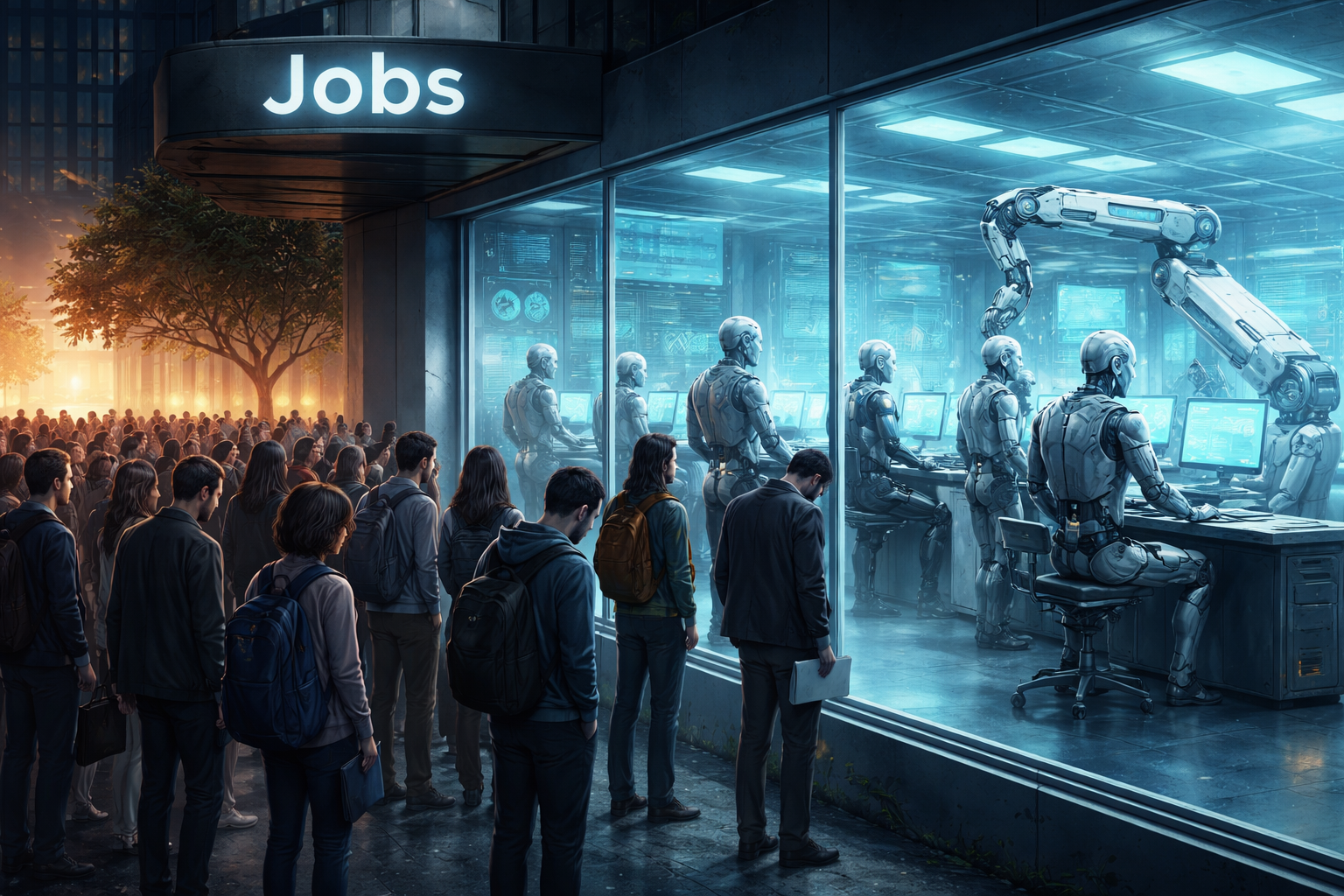
The concept of the “useless class” describes millions of people who may be displaced from traditional economic roles by increasingly autonomous technologies.
In recent years, the debate about the impact of artificial intelligence on employment has intensified. While many technologies promise to increase productivity, improve efficiency and create new professional opportunities, economists, sociologists and technology specialists are also raising concerns about the possibility of large-scale job displacement.
One of the most provocative ideas in this discussion is the concept of the “useless class”, a term used to describe a potentially growing segment of the population whose skills may no longer be required in an economy dominated by algorithms, automation and intelligent systems.

The origin of the concept
The term was popularized by historian and thinker Yuval Noah Harari, author of books such as Homo Deus: A Brief History of Tomorrow and 21 Lessons for the 21st Century.
Harari argues that throughout history technological revolutions have always eliminated certain jobs while creating new ones. However, he warns that artificial intelligence may be the first technology capable of replacing both physical and cognitive human abilities at the same time.
If machines become capable of performing complex tasks faster, cheaper and more accurately than humans, millions of workers could face serious challenges reintegrating into the labor market.
Automation and new inequalities
The concept of the “useless class” does not imply that people lack value as individuals. Rather, it refers to the possibility that many people could become economically irrelevant within traditional production systems.
In a highly automated economy, many tasks currently performed by humans could be handled by AI systems, including:
- data analysis
- basic programming
- customer service
- logistics and planning
- administrative processes
- technical diagnostics
Even professions that were once considered stable — such as junior lawyers, accountants or analysts — are already seeing parts of their work performed by AI tools in seconds.
This trend could create a widening gap between those who design, control or work with advanced technologies and those who are excluded from that ecosystem.
The challenge for Human Resources
For HR professionals, this scenario raises a crucial question: How can societies prevent large segments of the population from being pushed out of the labor market?
One of the key responses is professional reskilling.
Companies and talent organizations are increasingly prioritizing abilities that machines still struggle to replicate, such as:
- critical thinking
- creativity
- emotional intelligence
- leadership
- intercultural communication
- adaptability
At the same time, continuous learning is becoming essential for employability. Professionals who once relied on the same skills for decades may now need to update their knowledge constantly.
A future still being written
Although the idea of a “useless class” raises concerns, many experts argue that history shows societies also create entirely new professions when disruptive technologies appear.
Just two decades ago, many modern jobs did not exist, including:
- cybersecurity specialist
- big data analyst
- community manager
- user experience designer
- AI prompt engineer
Artificial intelligence is also creating new industries, from robotics to the data economy.
For this reason, many specialists prefer to see the current moment not as the emergence of a “useless class,” but as a profound transformation of the labor market, where human skills must evolve alongside technological progress.
The role of talent companies
For international recruitment platforms such as BajaStarTalent, this debate is particularly relevant.
The future of work will not depend only on technology. It will also depend on how organizations identify, develop and support human talent.
The key question is no longer whether artificial intelligence will transform employment.
The real question is which human abilities will remain uniquely valuable in an increasingly automated world.
And in that future, the capacity to learn, adapt and collaborate may become the most important skill in the global workforce