


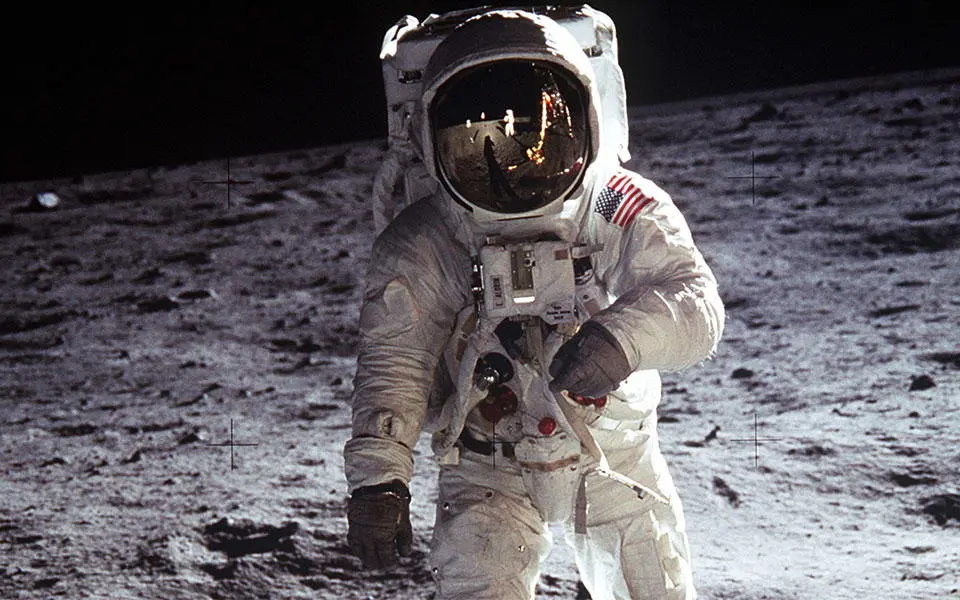
When Neil Armstrong stepped down the ladder of the Eagle lunar module and placed his boot on the Moon’s surface, it was not simply an astronaut reaching another world. For the first time, humanity crossed a boundary that, for thousands of years, had belonged only to imagination, philosophy, literature, and astronomy.
That historic moment marked the beginning of a new era. The Apollo 11 mission—crewed by Neil Armstrong, Buzz Aldrin, and Michael Collins—proved that scientific knowledge, technological innovation, and the combined efforts of hundreds of thousands of people could accomplish what once seemed impossible.
Fifty-seven years later, the Moon landing is still regarded as one of civilization’s greatest achievements—not only because of what happened that day, but because of everything it inspired in the decades that followed.
A Mission That United the World
The Apollo program was the result of the work of more than 400,000 engineers, scientists, mathematicians, technicians, and specialists across countless disciplines. Never before had a scientific endeavor brought together so much human talent in pursuit of a single goal.
The challenge was extraordinary. In just eight years, the United States went from having no astronauts in orbit to sending humans nearly 240,000 miles (386,000 kilometers) through space, landing them on another celestial body, and bringing them safely back to Earth.
Apollo 11 demonstrated that history’s greatest accomplishments are never the work of one individual. They are built on teamwork, vision, and the dedication of thousands working toward a common purpose.
Technologies We Still Use Today
Reaching the Moon required the invention of entirely new technologies, many of which eventually became part of everyday life.
The computers developed for the Apollo program pioneered the miniaturization of electronics and accelerated the evolution of integrated circuits that now power virtually every modern digital device. Advances in satellite communications, navigation systems, sensors, lightweight materials, battery technology, thermal insulation, and digital imaging also found applications far beyond space exploration.
Many innovations in modern medicine, water purification, smoke detection, emergency thermal blankets, and even materials used in today’s aerospace and automotive industries were either born from or significantly advanced by the space program.
In other words, Apollo 11 didn’t just change space exploration—it improved life on Earth.
The Day the World Looked Up Together
Perhaps Apollo 11’s greatest legacy was cultural rather than technological.
Millions of people watched the Moon landing live on television. For the first time in history, the world experienced a single event together in real time. For a few unforgettable hours, borders, languages, and political differences faded into the background. The Moon became a destination reached by all humanity.
Images of Neil Armstrong walking across the lunar surface became permanently etched into history, inspiring generations of engineers, physicists, mathematicians, astronomers, and explorers.
The mission also changed the way we viewed our own planet.
Soon afterward came the iconic photographs of Earth seen from space—a small blue world suspended in the vast darkness of the universe. Those images helped spark the modern environmental movement and reinforced the understanding that our planet is both unique and fragile.
An Experiment Still Working 57 Years Later
Apollo missions also revolutionized our understanding of the Solar System. Rock and soil samples collected on the Moon continue to be studied in laboratories around the world, providing valuable insights into the formation of both the Moon and Earth.
One experiment installed by Apollo astronauts remains operational today: a laser reflector placed on the lunar surface that allows scientists to measure the exact distance between Earth and the Moon. Thanks to this instrument, researchers confirmed that the Moon is slowly drifting away from Earth at a rate of approximately 1.5 inches (3.8 centimeters) per year.
More than five decades later, it remains one of the longest-running scientific experiments ever deployed beyond Earth.
A New Race to the Moon
The 57th anniversary of Apollo 11 arrives as lunar exploration enters a new era.
After decades in which the Moon was no longer the primary destination, the world’s major space powers are once again focused on Earth’s closest neighbor. The United States is leading the Artemis Program, which aims to establish a sustained human presence on the lunar surface. China and Russia are advancing their own lunar initiatives, while private companies are developing spacecraft, landers, and technologies that were once the exclusive domain of government space agencies.
The goal today is no longer simply to reach the Moon—but to stay there.
Scientists believe the Moon’s south pole may contain significant deposits of water ice, a resource that could provide drinking water, breathable oxygen, and even rocket fuel for future missions to Mars. Increasingly, the Moon is being viewed as a launchpad for deep-space exploration and a testing ground for the technologies that will shape humanity’s next great adventure.
A Legacy That Continues to Inspire
None of today’s ambitious space projects can be fully understood without looking back to what happened 57 years ago.
Apollo 11 proved that the limits of human knowledge can be expanded through vision, determination, and investment in science. It also delivered a timeless lesson: history’s greatest achievements are never accomplished alone—they are the result of countless people working together toward an extraordinary goal.
On July 20, 1969, humanity did more than reach the Moon.
It discovered a new way of imagining the future.
More than half a century later, Apollo 11 continues to remind us that every great breakthrough begins when someone dares to believe that the impossible can become possible.