


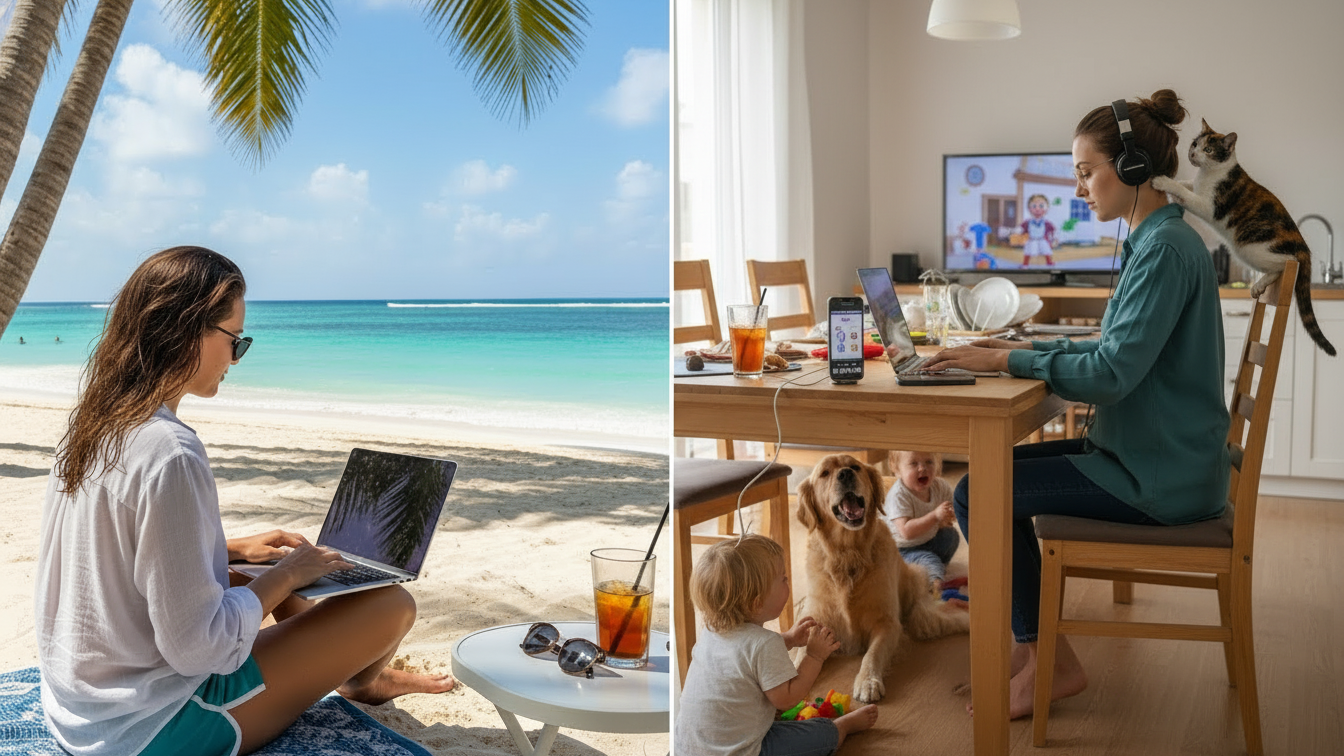
Working from home looks perfect on social media: beach views, aesthetic coffee cups, flexible schedules, and zero stress. But between the reels and real life, there’s a big gap. What are the true benefits of remote work—and what’s just a digital illusion?

Remote work has become one of the most desirable work models of the last decade. Social media portrays it as a dream lifestyle: people working from cozy cafés, stylish apartments, or tropical locations, all while smiling at their laptops. Everything looks calm, inspiring, and perfectly curated.
But those who actually live the remote work experience know it’s much more complex. It’s neither a permanent vacation nor a constant struggle. Like any work model, it has real advantages—and real challenges that don’t usually make it onto Instagram.
The Fantasy: You Can Work From Anywhere
One of the most common ideas is that remote work means you can work from anywhere: beaches, mountains, coffee shops, airports, or scenic rooftops.
Technically, that’s true—but only to a point. To work effectively, you need reliable internet, a quiet environment, proper lighting, and a comfortable setup. Most people eventually end up working from the same place every day: their home.
Working from a “dream location” often turns out to be more distracting than productive. Glare on your screen, uncomfortable chairs, background noise, and lack of privacy can quickly turn that perfect setting into a problem.
Remote work isn’t tourism. It’s still work—and it requires the right conditions.
The Real Advantage: Time and Money Savings
Here’s where remote work truly shines. Eliminating daily commutes saves hours of life each week. No traffic, no crowded buses or trains, no rushing out the door.
This extra time can be used to sleep more, exercise, cook healthier meals, or simply enjoy a slower pace of life. Expenses also drop: transportation, eating out, formal clothing, and other daily costs.
In many cities, especially large urban areas, this benefit alone can be life-changing.
The Fantasy: Total Schedule Freedom
Another common myth is that remote workers can work whenever they want. While some companies offer flexibility, most still require set hours, availability for meetings, and timely responses.
Remote work doesn’t remove structure—it reshapes it. In fact, many people end up working longer hours because the line between work and personal life becomes blurred.
That image of working just a couple of hours a day? It’s the exception, not the rule.
The Real Advantage: Greater Autonomy
One of the most powerful benefits of remote work is autonomy. There’s no constant supervision, no one watching your every move, no pressure to “look busy.”
This encourages workers to develop strong self-management skills: planning, prioritizing, and making independent decisions. For many, this sense of ownership over their work increases motivation and satisfaction.
Instead of being measured by how long you sit at a desk, you’re evaluated by your results.
The Fantasy: Perfect Productivity
Instagram shows spotless desks, perfectly organized planners, soft lighting, and aesthetic workspaces. Reality looks different: delivery interruptions, barking dogs, noisy neighbors, unstable internet, and tech issues.
Not everyone thrives in isolation. Some people need social interaction, external stimulation, or a change of scenery to stay focused.
Productivity in remote work doesn’t happen automatically. It’s something you build through routines, habits, and boundaries.
The Real Advantage: Better Work-Life Integration
For many people, remote work allows better balance between professional and personal responsibilities: childcare, education, side projects, or simply rest.
Being home to receive a package, prepare a proper meal, or take short breaks during the day might seem small—but these details significantly improve quality of life.
Remote work doesn’t make life easier—it makes it more adaptable.
The Fantasy: Less Stress
While remote work eliminates certain stressors, it introduces others: isolation, pressure to always be online, difficulty disconnecting, and the feeling of being “always available.”
Many remote workers struggle with guilt when they’re not working, even outside office hours. Over time, this can lead to emotional burnout.
Stress doesn’t disappear—it just changes shape.
What HR Teams Should Understand
For HR professionals, it’s essential to stop selling remote work as a flawless experience and start communicating it realistically.
It’s not just about providing laptops and video call tools. It’s about building clear policies, supporting mental health, setting reasonable expectations, and creating a culture of trust.
Remote talent needs structure, transparency, and leadership that values rest as much as productivity.
Remote work isn’t an Instagram fantasy—but it isn’t a nightmare either. It offers real advantages: time savings, autonomy, better work-life integration, and access to global opportunities.
But it also requires discipline, boundaries, emotional intelligence, and strong organizational support.
The biggest mistake is comparing it to a filtered version of reality. The truth is less aesthetic—but far more sustainable.
And when managed well, remote work can be one of the most powerful transformations in modern work culture.